"I lost 65+ pounds using your calorie calculator" Try it It's free
BMI Calculator
Body Mass Index
If you are under age 18, or want to find the BMI and appropriate weight for a child, please use the Childhood BMI Calculator.
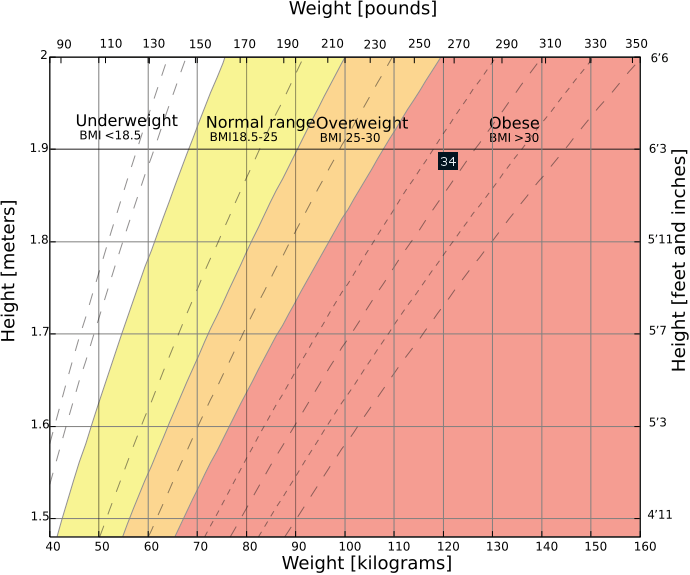
BMI uses a mathematical formula based on a person’s height and weight. Several government authorities use it when assessing overweight and obesity levels in the population.
This calculator uses a newer improved formula: 3.5 x kg / height ^ 2.5
- A BMI of 25 to 29.9 indicates a person is overweight.
- 30 or higher is considered obese.
The BMI does not measure body fat levels – so you could be rippling with muscle – and BMI will show obese.
BMI does not show the difference between excess fat and muscle. In children, waist measurement (and weight-to-height ratio) is a better predictor of cardiovascular disease than BMI.
Take your BMI reading with a grain of salt.
If a bodybuilder measured their BMI, they would show up as obese. This is obviously not true. It is difficult to apply a "one-size-fits-all" to unique body types. Some ethnic groups also have denser and heavier bone structure which can skew the results even more.
BMI is also inaccurate for short or tall people – short people will think they are thinner that what they are, and tall people will have a higher BMI reading. However, for the general population, BMI is an easy assessment of weight categories.
We recommend using the Body Fat Calculator instead.
BMI and Ethnicity
The BMI classifications apply for the entire population. However, some ethnic groups, such as Asians, should not necessarily have the same classifications.
Asian people with diabetes and cardiovascular disease risk have this at BMIs lower than the cut-off point for overweight (BMI 25).
- WHO, E. C. (2004). Appropriate body-mass index for Asian populations and its implications for policy and intervention strategies. Lancet, 363(9403), 157. Link
- Flegal, K. M., Carroll, M. D., Kit, B. K., & Ogden, C. L. (2012). Prevalence of obesity and trends in the distribution of body mass index among US adults, 1999-2010. Jama, 307(5), 491-497. Link
- Must, A., Dallal, G. E., & Dietz, W. H. (1991). Reference data for obesity: 85th and 95th percentiles of body mass index (wt/ht2) and triceps skinfold thickness. The American journal of clinical nutrition, 53(4), 839-846. Link
- Savva, S. C., Tornaritis, M., Savva, M. E., Kourides, Y., Panagi, A., Silikiotou, N., … & Kafatos, A. (2000). Waist circumference and waist-to-height ratio are better predictors of cardiovascular disease risk factors in children than body mass index. International journal of obesity and related metabolic disorders: journal of the International Association for the Study of Obesity, 24(11), 1453-1458. Link